

 Back
Back



PFAS Regulation – European Chemicals Agency Publishes Figures on Participation in the PFAS Restriction Consultation
The 60-day consultation period of ECHA’s Committee for Socio-Economic Analysis (SEAC) closed with the submission of 3,511 comments.
On January 3, 2023, the European Chemicals Agency (ECHA) published a restriction proposal developed by the national authorities of five European countries with the aim of reducing PFAS* emissions. Its objective is to prevent further accumulation of the entire PFAS substance group in the environment. During the six months that followed, all affected parties had the opportunity to provide ECHA with information on the scientific, technical and economic aspects of a potential PFAS restriction. Freudenberg Sealing Technologies used this consultation period to highlight relevant aspects of the responsible use of fluoropolymers in sealing materials for various industrial applications, both through industry association working groups and through its own participation. [MB1.1]
In March 2026, two resolutions were published: ECHA’s Committee for Risk Assessment (RAC) adopted its final opinion on March 2 under the title “Evaluation of sector-/use-specific aspects of the opinion on an Annex XV dossier proposing restrictions on Per- and polyfluoroalkyl substances (PFAS)”.
The Committee for Socio-Economic Analysis (SEAC) published its preliminary opinion on March 10, 2026, followed by a 60-day consultation period. This opportunity to submit comments again generated strong interest among stakeholders worldwide, in sectors including industry (61.6%), industry and trade associations (25.9%), civil society (7.7%), as well as science, public authorities and NGOs. Freudenberg Sealing Technologies participated by submitting its own response and by cooperating with relevant industry associations. On June 3, 2026, ECHA published further details of the stakeholder participation. An overview:In total, SEAC received 3,511 comments and submissions from more than 3,200 companies and institutions, as well as from 250 individuals. Submissions from Germany accounted for the largest share with more than 1,000 comments. This was followed by submissions from Japan, Belgium, France and China.
The data was collected by means of a structured questionnaire and consisted of a general survey on the statements contained in SEAC’s draft opinion, a specific survey on PFAS manufacturing, and 14 sector-specific questionnaires for application areas assessed by SEAC.
Comments were received as follows: 45.1% were related to the general assessment and evaluation, 12.7% to electrolyzers and semiconductors, 6.6% to applications using fluorinated gases, 6.2% to the energy sector and 6.1% to the use of PFAS in transportation. The use of PFAS in lubricants was addressed in 5.3% of the submitted comments. The remaining 18% of the responses concerned PFAS manufacturing, medical technology, metal plating, construction materials, food and packaging materials, textiles, various consumables, petroleum and mining, cosmetic products and ski wax.
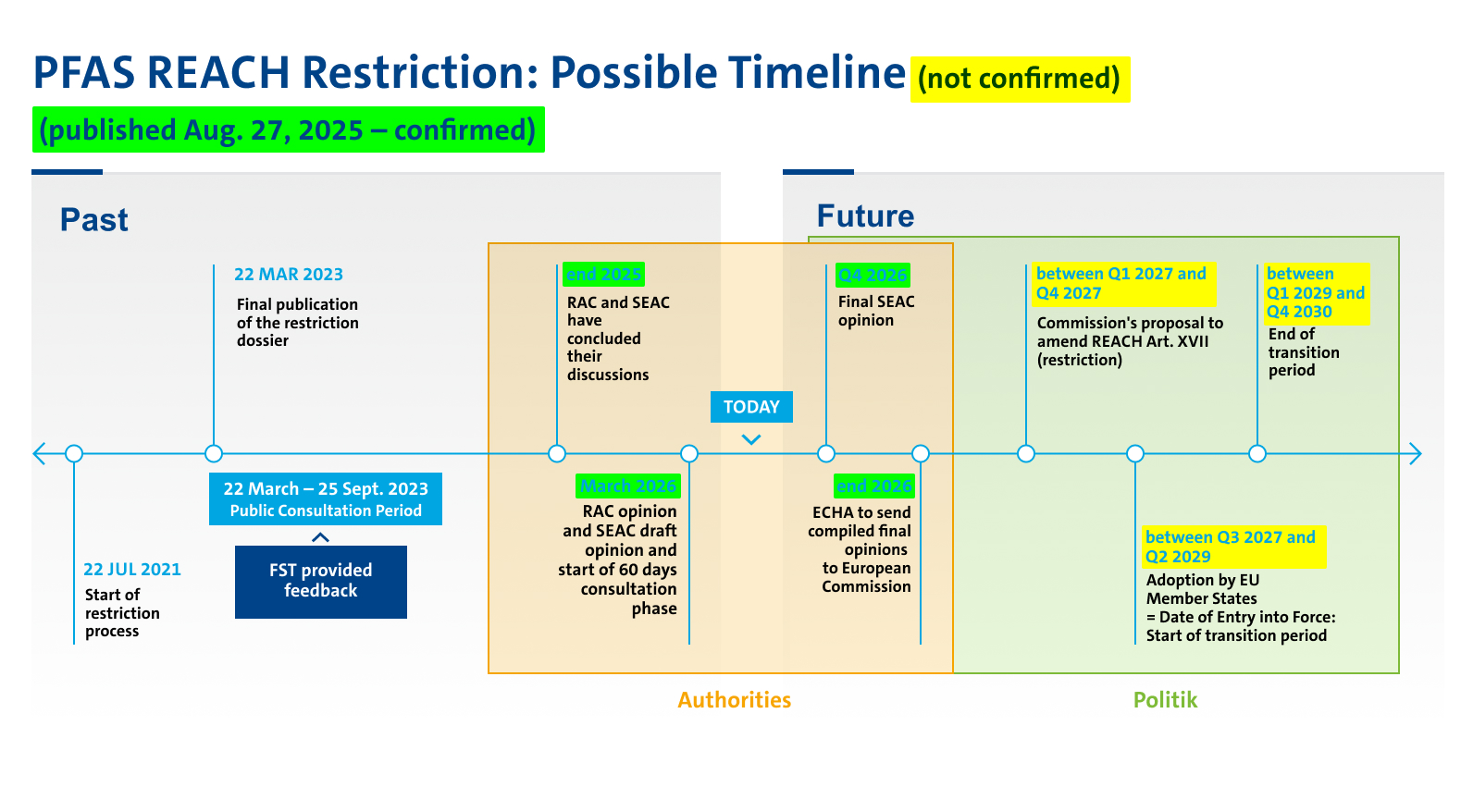
All submissions received as part of the consultation are publicly available on the ECHA website unless they were marked as confidential. SEAC will now review all comments and adopt its final opinion by the end of 2026. This will conclude the scientific assessment of the proposed PFAS restriction process by the ECHA committees. Once the opinions have been officially submitted to the European Commission, the Commission will prepare a legislative proposal for the PFAS restriction. Then this proposal will be submitted to the REACH Committee of the Member States for consultation and a vote.
Important to know: As soon as the PFAS restriction enters into force, it will be binding on all relevant economic operators. This will include manufacturers, importers, distributors, downstream users and retailers. The competent authorities of the EU Member States will be responsible for monitoring compliance with the restriction and for its enforcement.
* PFAS definition: Any substance that contains at least one fully fluorinated methyl (CF3-) or methylene (-CF2-) carbon atom (without any H/Cl/Br/I attached to it).
PFAS REACH restriction: Possible timeline (not confirmed)
The following graphic shows the next steps:
Freudenberg Sealing Technologies will continue to offer fluoropolymer-based materials such as PTFE and FKM, as these fluoropolymers provide exceptional resistance to temperature, corrosion, chemicals and wear and are recognized as having no significant impact on the environment or human health. The properties of these materials also enable a broad range of applications and provide resistance to a wide variety of fluids. Our goal is to meet the needs of our customers. Accordingly, we utilize these high-performance materials as part of our long-term supply strategy, which includes both external and internal sources.
We will closely monitor further developments related to the restriction proposal and other regulatory requirements in order to remain a reliable partner for our customers.
We also offer many other high-performance materials in our portfolio that do not contain any fluoropolymers. Drawing on our many years of experience and expertise in material development and testing, we continuously evaluate and develop application-specific alternatives.
In addition to the ongoing EU restriction proposal, we are closely monitoring the latest developments and reporting requirements outside Europe. We will comply with the applicable requirements and coordinate with our affected customers as soon as reporting obligations enter into force.
Here you can find our statement (original English version) on ECHA and the planned restrictions.
Below you will find several questions and answers regarding the current situation.
Below you can find a Q&A further explaining the current situation.

OMK-PU 30500: The Perfect PTFE Alternative
Experience the evolution of sealing technology with OMK-PU AU 30500, the perfect PTFE alternative that offers superior performance and sustainability.

 Back to Top