

 Back

18.11.2026 | News
DIAvent® maxFlow: Precise Control of Opening Pressure for Emergency Venting
Emergency degassing valve for traction batteries with a high venting rate


A battery pack must offer reliable protection against water ingress, pass leak testing after production and still provide rapid degassing in an emergency. In electric vehicles, these requirements drive the rupture disks to their limits. Their opening pressures can vary significantly and they remain open after triggering. Freudenberg Sealing Technologies has developed a solution: the DIAvent® maxFlow, an emergency degassing valve with an adjustable opening pressure.
When a battery cell undergoes thermal runaway, an emergency degassing valve must quickly vent the resulting gas from the housing. Conventional rupture disks open at around 200 to 250 millibar with a variation of up to plus/minus 100 millibar.
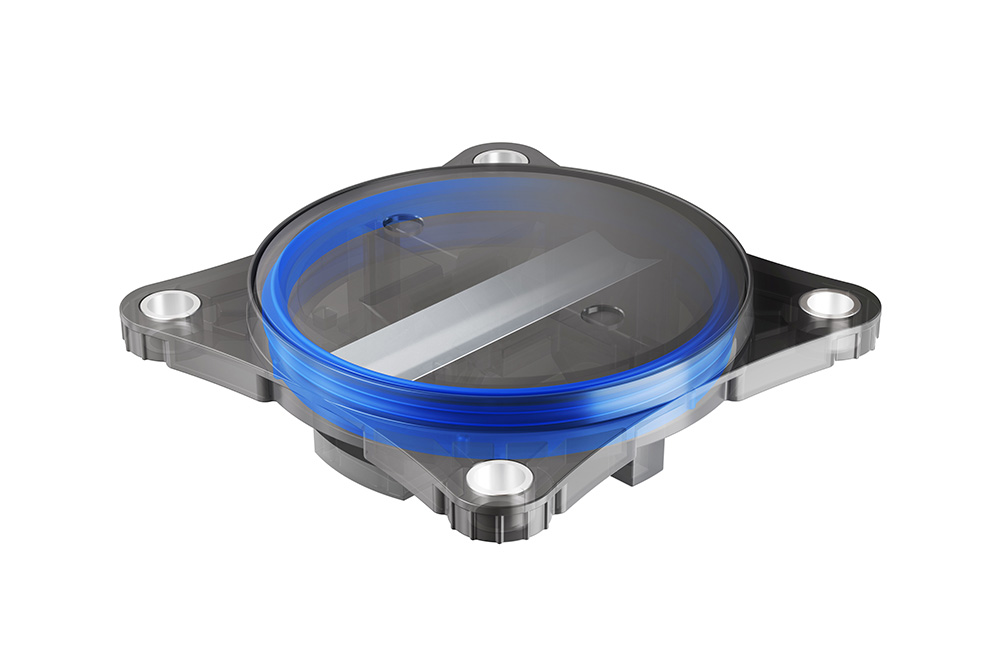
Replacing rupture disks with a spring
The DIAvent® maxFlow uses a profiled flat spring instead. Its activation pressure can be set anywhere between 50 and 200 millibar, where the tolerance for 100 millibar is plus/minus 15 millibar. Once the interior pressure reaches this level, the spring opens almost fully in an instant. Traditional coil-spring solutions require a substantial further increase in pressure after the activation level is reached. With the DIAvent® maxFlow, there is a significant difference between the opening and closing pressures. For example, a valve can open at 70 millibar and close again only when the pressure falls to around 35 millibar. A high activation pressure prevents harmless pressure fluctuations from inadvertently opening the valve, while a lower closing pressure minimizes the residual pressure in the system.
High venting rates in compact spaces
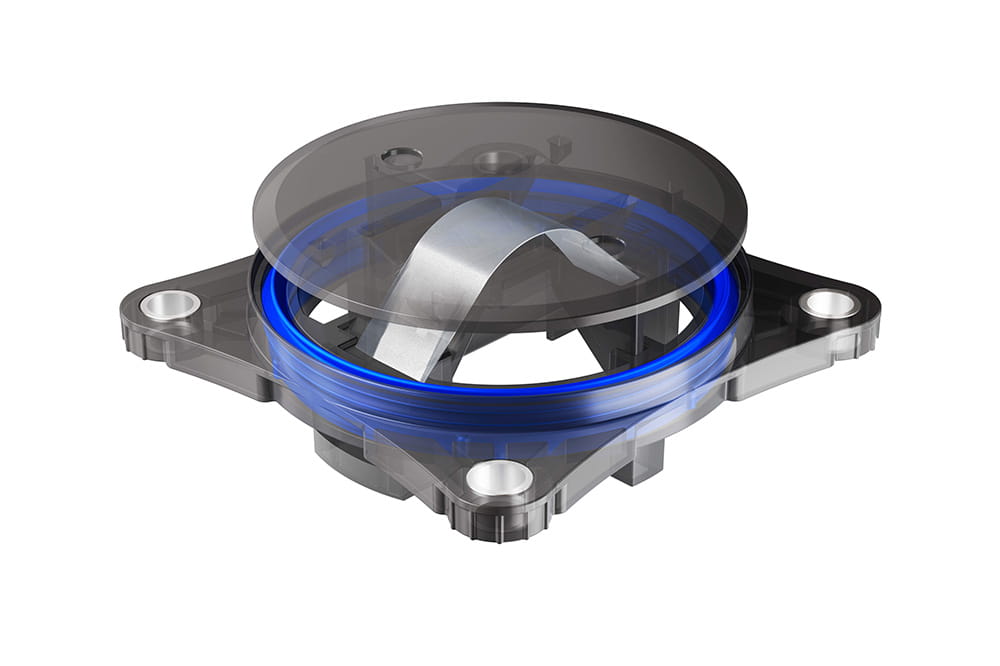
At a differential pressure of 300 millibar, the emergency degassing rate exceeds 190 liters per second. That is 2.5 times the rate of the DIAvent® HighFlow, another valve model in the product family. With a footprint of 86 x 86 millimeters, the height of the DIAvent® maxFlow is only 12.1 millimeters when closed and 23.4 millimeters when open. The company can also produce other dimensions upon request. Because the valve closes again, Freudenberg Sealing Technologies can test the functionality of every single unit before delivery without damaging it. This would be impossible with rupture disks.
Cover and housing set to customer request
The valve is closed during normal operation. If it closes again after a thermal event, this prevents oxygen from entering the battery housing from outside. But this also makes it difficult for extinguishing agents to reach the source of the fire. That is why different designs are possible to meet the customer’s safety concept: The standard version closes again, while another option leaves a narrow gap open to prevent access or allows the cover to detach completely for maximum venting capacity. The housing is available in plastic or aluminum.
“With the DIAvent® maxFlow, we have addressed the drawbacks of previous venting solutions in a single product, enabling us to significantly improve both safety and flexibility in battery development,” says Daniel Uhl, Head of Product Management at Freudenberg Sealing Technologies.
Additional information on the DIAvent® maxFlow can be found here: DIAvent® Pressure equalization
More news on the subject Technology & Innovation
Technology & Innovation
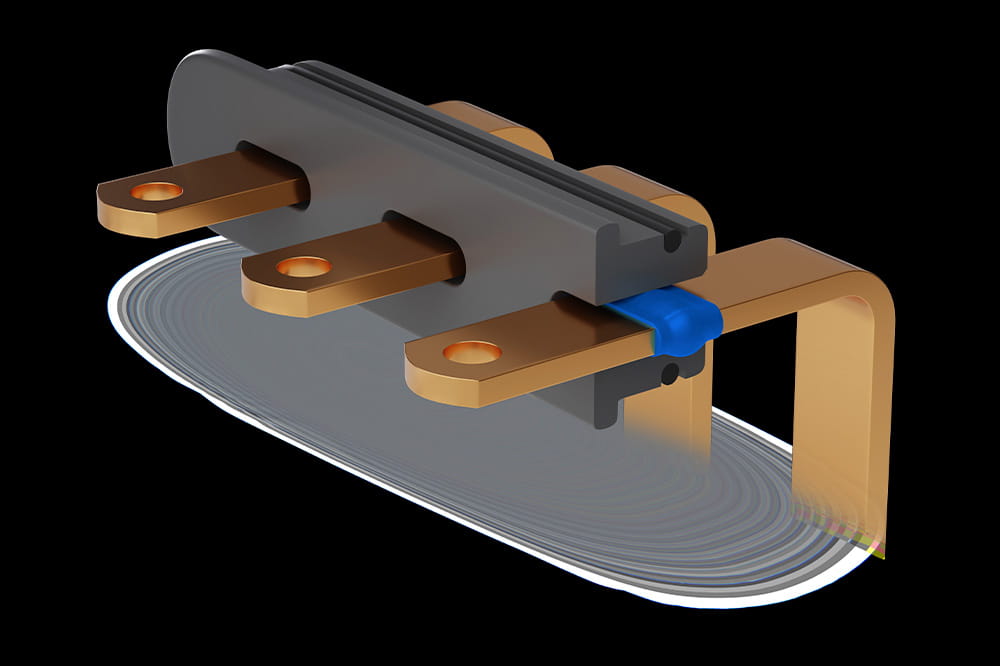
Durable Sealing Of Busbar Feedthroughs: Replacing Epoxy With Elastomer
Where copper wiring passes through housing walls, thermal stress can cause microcracks in conventional potting compounds. To prevent this, Freudenberg Sealing Technologies relies on bonding solutions that overcome this problem.
Technology & Innovation
Innovation Driver: Connector Seals Improve Design Flexibility in Battery Platforms
With its connector seals, Freudenberg Sealing Technologies has developed a customer-specific, configurable concept that supports new system-level approaches in the technological advancement of modern battery packs.

Technology & Innovation
DIAvent® maxFlow For High-Performance Batteries
High degassing rate and adjustable trigger pressure for sophisticated battery systems

Technology & Innovation
Modular TPE Bellows for Special-Purpose Vehicles and Industrial Applications
Freudenberg Sealing Technologies is expanding its portfolio of bellows with a new manufacturing process for small-batch production. For the first time, custom-designed bellows made of thermoplastic elastomer (TPE) can be produced with significantly reduced tooling and fixed costs. This is feasible due to a modular tooling concept developed specifically for application-specific bellows geometries in small quantities.

Technology & Innovation
FACT Surface Technology for the Environment: An Adhesive Bonding Process Without Wet-Chemicals
Can bonding processes be designed to work without wet-chemicals? Yes. With FACT, Freudenberg Sealing Technologies is establishing a new, cost-efficient, and sustainable manufacturing process.

Technology & Innovation
Freudenberg-NOK Sealing Technologies introduces FN Lube and FN Lube Plus
Purpose designed lubricants support consistent installation and material compatibility for static seal applications.

Technology & Innovation
Technology Transfer: Automotive Hydraulic Accumulators Prove Their Value in Agriculture
A hydraulic accumulator originally developed for the automotive industry is opening up new possibilities for agricultural machinery operating under extreme conditions. Freudenberg Sealing Technologies has successfully transferred proven passenger car technology to a demanding new application.

Technology & Innovation
Santa Ana Facility Wins Prestigious IndustryWeek Award
Freudenberg Sealing Technologies (FST) has received the 2025 IndustryWeek Best Plants Award for its Santa Ana, California facility, marking the first time an FST site has earned this distinction in the program’s 35-year history.

Technology & Innovation
Dr. Ruth Bieringer to Become President of the German Chemical Society (GDCh)
On January 1, 2026, Dr. Ruth Bieringer, Vice President Technology & Innovation – Material Technology at Freudenberg Sealing Technologies, takes over as president of the German Chemical Society (GDCh).
 Back to Top